Filtration looks like the simplest operation in the laboratory, and it is the one where quiet errors are easiest to introduce. A filter that passes fine particles ruins a gravimetric determination; one that is too retentive turns a five-minute step into an afternoon.
Filter media are specified by particle retention, flow rate, ash content and chemical compatibility. Those four properties, read together, tell you whether a filter suits your method.
Retention against flow rate
Particle retention is quoted in micrometres and describes the size of particle the filter reliably holds back. Flow rate describes how quickly liquid passes through.
The two are inversely related. A tightly retentive paper is necessarily slower, so a filter that retains very fine precipitates will take longer, and one that filters quickly will let finer particles through. There is no medium that does both, which is why the choice has to follow the method.
The main classes of filter paper
| Class | Character | Typical application |
|---|---|---|
| Qualitative | General purpose cellulose, moderate ash content | Routine clarification, teaching laboratories, sample clean-up |
| Quantitative | Acid-washed, low ash residue | Gravimetric analysis where the paper is weighed or ignited |
| Ashless | Very low residue on ignition, typically under 0.01% | Gravimetric determinations involving ignition of the precipitate |
| Hardened | Treated for wet strength | Vacuum filtration and Büchner funnel work |
| Glass microfibre | Binder-free borosilicate, high loading capacity | Air and water monitoring, fine precipitates, high temperature |
Membrane and syringe filters
Where a paper filter clarifies, a membrane filter defines a sharp cut-off. Standard pore sizes of 0.45 µm and 0.22 µm are used for mobile phase preparation, sample filtration before injection and sterile filtration respectively.
Material choice governs compatibility. Nylon and PTFE suit organic solvents, PES and cellulose acetate suit aqueous solutions with low protein binding, and PVDF is a common general-purpose compromise. Filtering an aggressive solvent through the wrong membrane can extract material from the filter straight into your sample.
Choosing filtration hardware
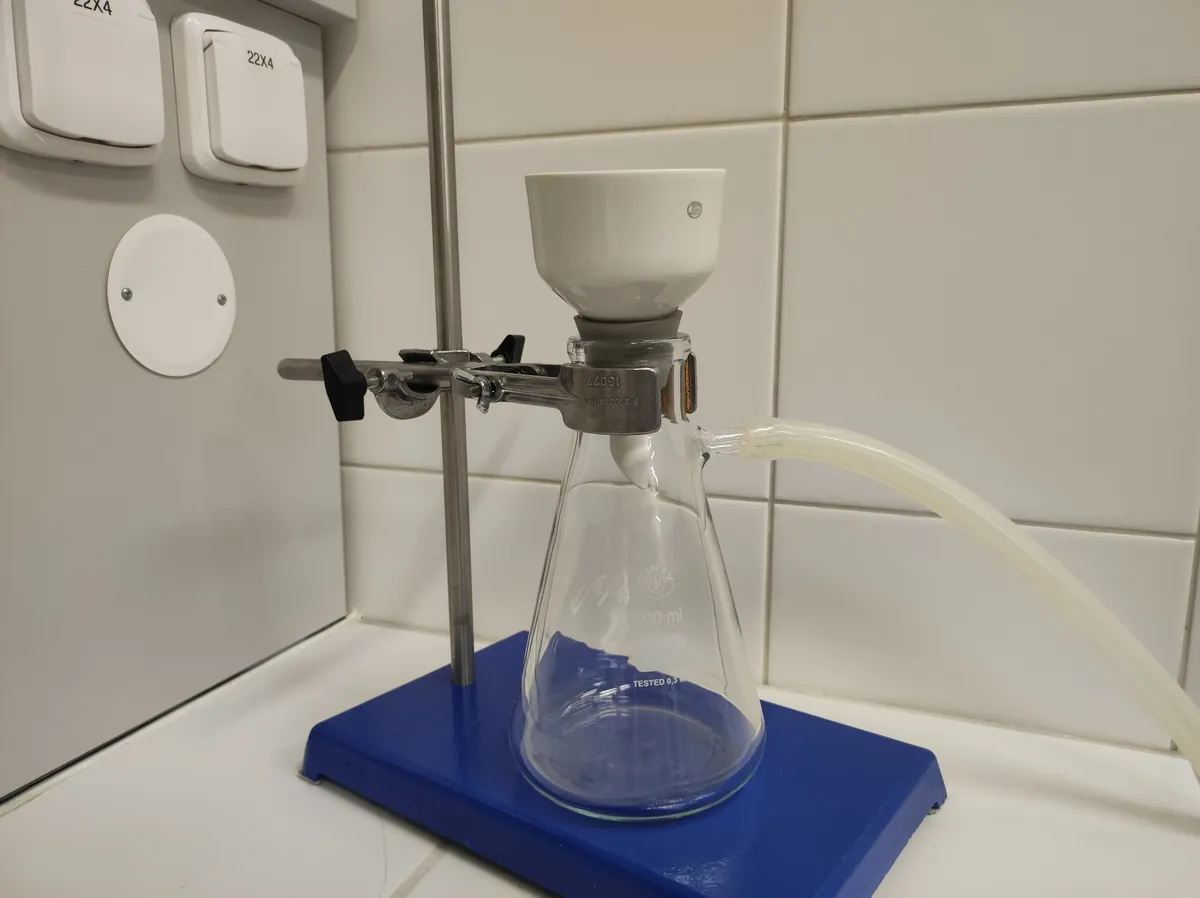
- Büchner funnel and filtering flask for vacuum filtration of bulk volumes.
- Filter holders — in-line or open-faced — for membrane filtration of larger volumes.
- Syringe filters for single samples immediately before injection or analysis.
- Filter pipette tips where aerosol carryover must be prevented in molecular work.
- Extraction thimbles for Soxhlet extraction.
Choosing a diameter and a format
Filter papers are supplied as circles in a range of diameters, and the correct one is set by the funnel rather than by the sample. The paper should sit inside the cone with its edge just below the rim; a paper that protrudes will wick liquid over the edge and lose sample.
Volume then decides the grade rather than the size. A large volume through a small, retentive paper will blind the surface long before the sample has passed, so where both fine retention and volume are required, a pre-filter of a coarser grade ahead of the fine one is usually faster than forcing everything through a single membrane.
Practical points that save reruns
- Pre-wet membranes with the solvent you will use, and discard the first small volume of filtrate.
- Match the filter diameter to the volume; an undersized filter blinds and slows to a halt.
- For gravimetric work, confirm the paper is genuinely ashless rather than merely quantitative.
- Fold or fit the paper so it seats against the funnel cone, since a leak past the edge invalidates the separation entirely.
- Store papers flat and dry — cellulose is hygroscopic, and a damp paper weighs differently.
- Fluted papers give a far higher flow rate than a simple quartered fold, because more of the surface is in contact with liquid rather than the funnel wall.
Mistakes that quietly spoil results
The most common is extractables. Passing an aggressive organic solvent through a membrane chosen for aqueous work can leach material from the filter or its housing directly into the sample, producing peaks that are blamed on the sample for weeks.
The second is adsorption. Protein and other large molecules bind to some membrane materials, so a low-binding membrane matters whenever the analyte is present at low concentration and you cannot afford to lose part of it to the filter.
The third is simply not running a blank. Filtering pure solvent through the same filter, under the same conditions, and analysing the result takes a few minutes and settles both questions definitively.
Most filtration problems are specification problems rather than technique problems. Deciding whether your method is limited by retention or by throughput answers the question almost every time.
This article is a general procurement guide. Always follow the manufacturer safety data sheet and your own laboratory policy before handling or specifying any chemical.